Cornish Rex Cat Insurance, Care and Health Advice
While the Cornish and Devon Rex breeds may look similar, they're the result of different mutations and so are distinct cat breeds. If you're hoping to make one of these loveable characters a new member of your home, then here's everything you need to know to keep them purring.
Cornish Rex Facts


Is a Cornish Rex Cat Right for Me?
Calm Cornish Rex behaviour means these cats will get along with everyone, including other pets in the home. They love human company and will fit in well with families and busy households. If you can give them the attention they want and make time for interactive play together, you'll be rewarded with lots of affection.
The Cornish Rex came about as the result of a spontaneous genetic mutation. In 1950 in Cornwall, England, a farm cat gave birth to a litter of five kittens, one of which had a distinctive curly coat.
The owner, Nina Ennismore, back bred this curly-coated male cat with the mother, and two out of the three kittens also had the curly-coated gene (known as the rex gene). Other cat breeds, including the Burmese, Siamese and British Domestic Shorthair, were then used to broaden the genetic pool and the Cornish Rex breed was created.
While the Cornish and Devon Rex breeds may look similar, they're the result of different mutations and so are distinct cat breeds.
What are Cornish Rex Kittens Like?
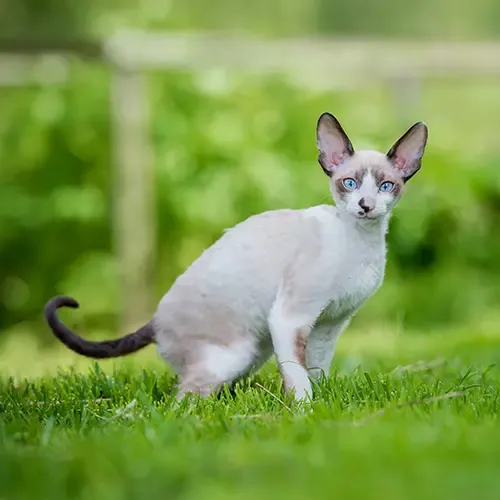
Cornish Rex kittens are full of mischief. Curious, adventurous and lively – they'll want to play all the time. While the breed is sociable and people-oriented, make sure that the kittens have been socialised from an early age so that they grow into confident adults.
They tend to retain their kitten-like behaviour well into their senior years!
Life with a Cornish Rex
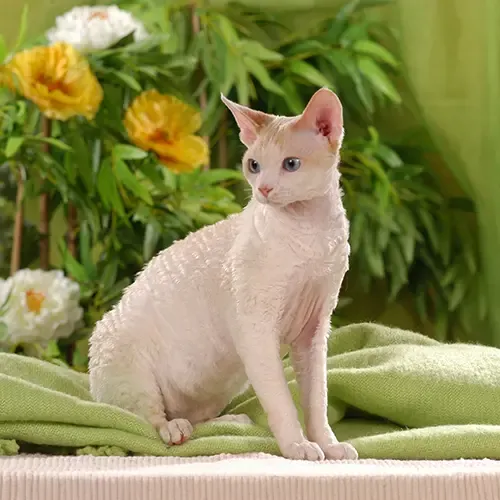
The Cornish Rex likes to be in the middle of everything. These adventurous cats love exploring, climbing and playing. Known for their acrobatic and funny antics, life won't be dull with a Cornish Rex around. They remain playful even as adults. They're not usually vocal but communicate what they want with their expressive eyes and body language.
Caring for Your Cornish Rex
If you buy your Cornish Rex kitten from a breeder, ask if they can provide you with a feeding schedule. Follow this schedule by feeding the same kitten food at the same time every day. If you want to change their diet, it's best to do so gradually. Add small amounts of the new food to the old food, slowly increasing the new and reducing the old. This will help to avoid any stomach upsets.
Like all cats, the Cornish Rex should be fed a high-quality cat food. If you're unsure how much to give, check the recommendations on the food packaging or ask your vet or vet nurse for advice. As they have high activity levels, you probably don't need to worry too much about overfeeding them.
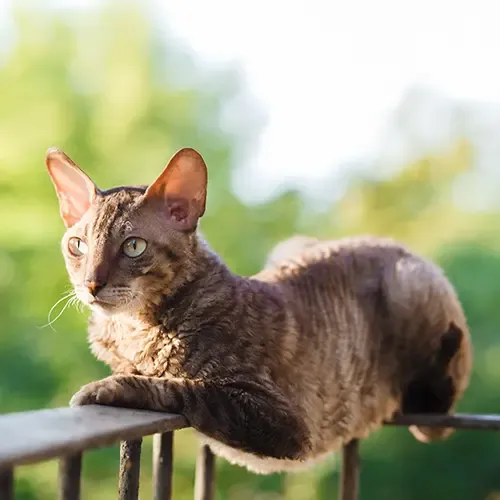
The Cornish Rex has a coat that requires little to no grooming. They have no guard hairs (outer fur) and just have a downy undercoat, which is fine and wavy or curly. Their silky and soft coat folds into tight rows of small curls and comes in a wide variety of colours and patterns. Hand grooming once a week to remove any loose hairs is all they need. Their whiskers and eyebrows are also curled. They have large ears, long legs, long and slim tails, and faces that are described as being 'egg-shaped'.
Slender and athletic, the Cornish Rex is a lively, active cat that enjoys playing with interactive toys, climbing up cat trees (and furniture) and jumping back down. They're an intelligent breed, so training is a breeze. Litter training kitten will be picked up quickly, and they can even be taught to play 'fetch', walk on a lead and other tricks.
Although they are a small-to-medium sized cat, the Cornish Rex has muscular back legs, which enable it to run fast and jump high. This, along with their sleek appearance, means that they're sometimes described as the Greyhound of the cat world.
Cornish Rex Insurance
Happy to go with the flow, Cornish Rexes are perfect for couples or families with other pets. Their inquisitive and playful nature also means they'll never get bored of a game or two either. Plus, because the breed can live long into their late teens, you're free to enjoy many happy years together.
For all those fun years, it helps to have insurance that can stay with you forever, that's where Everypaw’s Lifetime Cat Insurance comes in. With a host of bonus features like vet fee cover anywhere in the EU and 24/7 access to vet support via PawSquad, there's no end to the adventures you could pack into your Cornish Rex's life.
Common Cornish Rex Cat Health Problems by Vetstream
The Cornish Rex may look dainty and fragile, but they're generally a robust and healthy cat breed. Regular health checks will help identify any health issues. Everypaw has teamed up with veterinary experts Vetstream to help you spot any signs of these.
Congenital hypotrichosis is a condition that causes hereditary baldness. The Cornish Rex breed can be affected. Kittens with the condition are either born without any hair or lose hair within a few weeks. Hairless cats will need sunscreen protection if allowed outside, especially on their ears, which are particularly prone to sunburn. Affected cats should not be bred from.
Cardiomyopathy means disease of the heart muscle, and with HCM in cats, the muscle becomes abnormally thick (hypertrophic). The heart then can't work properly, and this can lead to heart failure. This serious heart condition can affect many breeds of cats. There's no cure, but long-term medication can help keep cats stable.
While a luxating patella may be a result of trauma, it may also be due to a hereditary problem in some cat breeds. The Cornish Rex is a breed which is susceptible to the condition. The patella (kneecap) becomes unstable and slips in and out of place. You may notice your cat hopping or limping if the patella has been displaced. The degree of patellar instability is classified into 4 grades of increasing severity. Surgery is needed to manage severe cases.
Like other cat breeds, the Cornish Rex can be affected by dental issues, especially as they get older. Get into the routine of regularly brushing their teeth and checking for any signs of periodontal disease (the area around the teeth). Bad breath and difficulty eating can be signs of disease.

Quick Cornish Rex Q&A
A Cornish Rex is a breed of cat that originated in Cornwall, as the name suggests. Their distinctive curly coat is a result of a natural mutation. The term 'rex' refers to the gene mutation responsible for the curly or wavy coat. The rex coat is also seen in other cat breeds such as the Cornish Rex, Selkirk Rex and LaPerm breeds.
Yes, they do shed, especially during spring and autumn. However, they do have a lower tendency to shed than other breeds, which may be good news for those with cat allergies. They have no outer hair (guard hair) and only have a soft undercoat.
No, despite their fine, short coats, they're not hypoallergenic. All cats produce Fel d1, the protein responsible for cat allergies, in their saliva and dander. However, because they're low shedders, allergy sufferers may tolerate this breed better than others.
Cornish Rex cats are generally long-lived, and it's not unusual for them to live to over 16 or even 20 years. They're a healthy breed and will live to a grand old age if well-cared for. Always buy from a reputable breeder so you can make sure that your kitten is free from any inherited health issues.
That’s All You Need to Know About Cornish Rex Cats
Elegant, slender, intelligent and lively, the Cornish Rex will keep everyone entertained with their antics. Their curly or wavy coats are easy to care for, but, as they don't have guard hairs, only having a fine undercoat, they like to be kept warm. They love human company, running, jumping and playing, after which they like nothing better than a warm lap to curl up on or a shoulder to drape over.
Content provided from Vetstream's Vetlexicon Felis.
Vetlexicon is the world’s largest peer-reviewed online clinical reference source. All our content is written and peer-reviewed by over 1,000 of the world’s leading veterinarians, ensuring relevance, accuracy and quality.
- Vetstream Ltd (online) Cornish Rex. In: Vetlexicon Felis. Vetstream Ltd, UK.
- Rosanna Marsella, Ian Mason, David Scarff (online) Congenital hypotrichosis. In: Vetstream Felis. Vetstream Ltd, UK.
- Serena Brownlie, Phil Fox, Philip K Nicholls, Penny Watson (online) Heart: hypertrophic cardiomyopathy. In: Vetlexicon Felis. Vetstream Ltd, UK.
- Vetstream Ltd (online) Cardiomyopathy in your cat Owner Factsheet. In: Vetlexicon Felis. Vetstream Ltd, UK.
- Mark Thompson, Matthew Oxford (online) Periodontal disease. In: Vetlexicon Felis. Vetstream Ltd, UK.
- Vetstream Ltd (online) Periodontal disease and how to prevent it. In: Vetlexicon Felis. Vetstream Ltd, UK.
- Sorrel Langley-Hobbs, Rosanna Marsella, Susan Rackard (online) Patella: luxation. In: Vetlexicon Felis. Vetstream Ltd, UK.


